Fluency · Adult Learners · 5 min read
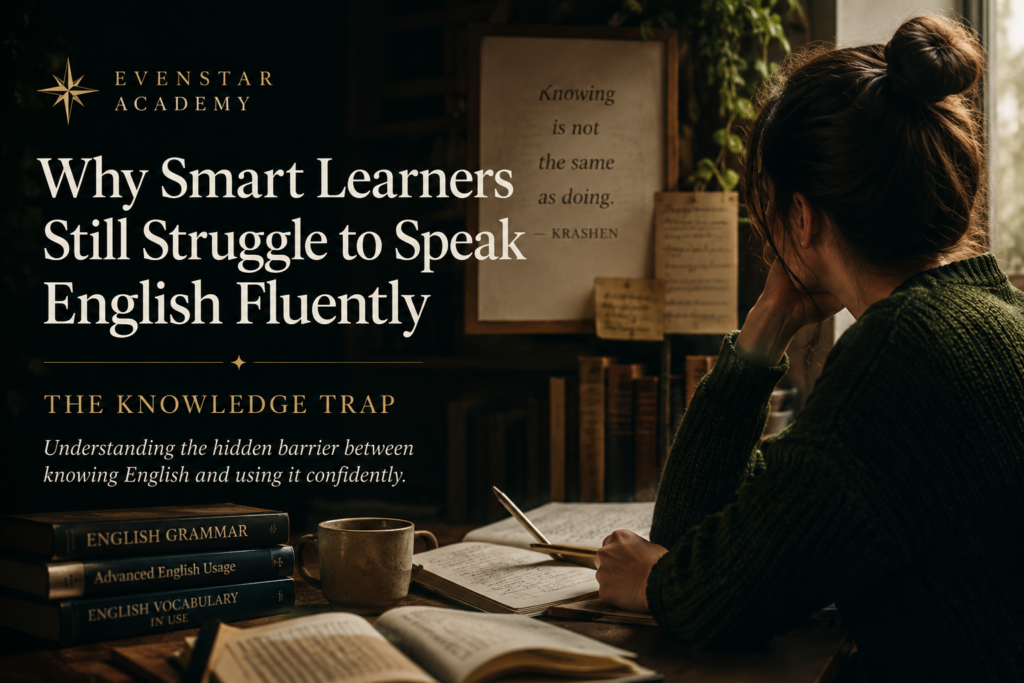
You may already know more English than you think. The real struggle for many adult learners is not understanding the language it is learning how to trust themselves enough to use it.
Most adult English learners have spent years studying the language. They are familiar with grammatical structures, recognize a considerable range of vocabulary, and often comprehend films, videos, and conversations far more effectively than they can participate in them verbally.
Yet when confronted with a simple conversational question in English, many experience an immediate cognitive block. The issue is rarely the absence of knowledge itself. Rather, spoken production under social and psychological pressure operates very differently from controlled, individual study.
This is where many adult learners become trapped. In response to communicative difficulty, they return repeatedly to grammar study, assuming that an additional rule or explanation will eventually produce fluency. In many cases, however, the opposite occurs: increased conscious monitoring begins to interfere with spontaneous communication.
The Knowledge Trap
There’s a painful gap that most learners never talk about: you can understand almost everything and still be unable to say anything. Linguists call this the difference between passive and active competence. You’ve absorbed the language through years of reading and studying but you’ve never really used it under pressure.
The more grammar you study, the worse this can get. You start monitoring every sentence before it leaves your mouth. Is that the right tense? Did I use the article correctly? Was that preposition wrong? By the time you’ve checked everything, the conversation has moved on and you’ve said nothing.
" The best methods are those that supply comprehensible input in low-anxiety situations not those that force and correct production."
— Stephen Krashen, linguist, USC
Krashen spent decades studying how people actually acquire language. His conclusion was uncomfortable for traditional teaching: conscious grammar learning doesn’t drive fluency. It helps you monitor your output and catch mistakes in writing, check a sentence before sending an email. But in real conversation, it mostly gets in the way.
Fear Is the Real Barrier
Ask any adult learner what stops them from speaking and they’ll rarely say “I don’t know enough grammar.” They’ll say: “I’m afraid of making mistakes.” Or: “I don’t want to sound stupid.” Or simply: “My mind goes blank.”
51%
of language learners report intense self-consciousness when speaking in front of others regardless of their actual grammar knowledge. (2025 study on language learning anxiety)
Krashen called this the Affective Filter the emotional wall that blocks language from becoming usable. Anxiety, self-doubt, and the fear of judgment raise this filter. When it’s up, comprehensible input stops converting into real communication.
The irony is that over-studying grammar can raise that filter, not lower it. The more rules you know, the more things there are to get wrong.
What Actually Works
Real communication happens when you stop trying to be correct and start trying to be understood. These are two very different goals.
Children don’t learn their first language by studying grammar rules. They hear language in context, they experiment, they make mistakes constantly and nobody fails them for it. Adult learners can do the same, but they need an environment that makes it safe to be imperfect.
This is why the most effective adult learners aren’t the ones who study the hardest. They’re the ones who speak the most, worry the least, and treat every mistake as data not failure.
"We acquire language in one way and only one way: when we understand messages. Not how they say it but what they say."
— Stephen Krashen, linguist, USC
This means the goal of any serious English learner should not be to master the subjunctive. It should be to get comfortable being uncomfortable to build the habit of reaching for words even when you’re not sure they’re perfect.
A Different Starting Point
If you’re an adult learner reading this, here is a reframe worth sitting with: you probably already know enough grammar to have a real conversation. What you don’t have yet is the confidence to use what you know under pressure.
That confidence doesn’t come from another grammar workbook. It comes from conversations messy, imperfect, real ones. It comes from a teacher who designs your learning around your thinking style, not around a one-size-fits-all syllabus. It comes from understanding that fluency is not the absence of mistakes. It’s the ability to keep going anyway.
The grammar will follow. It always does.
Written by an ELT specialist based in Istanbul
CELTA-certified English teacher working with Turkish adult learners. Specializes in customized materials based on individual learning profiles and intelligence types.